When to Conduct a Lease Audit

Tristan Douville
Senior Product Manager
Key takeaways
- Leases are usually audited in three scenarios: before you sell, before you buy or take over a property, or on a regular cadence in between.
- Sellers who audit early can fix what they find on their own schedule. Buyers who audit before closing can use what they find in negotiation.
- Owner/operators audit to recover revenue and clean up their own files. Fee managers audit for a client to ensure they're providing excellent services.
- Lease Auditor pricing starts at $2 per unit, so you can audit across disposition, acquisition, and continuous checks without outsourcing each run.
Most teams run a lease audit when a deal forces one. A sale is coming, a buyer wants the files checked, or a new management contract starts. That works, but it means errors that began months ago show up in one pile, with a deadline attached. This means your operations teams are all-hands-on-deck to make sure the deal goes smoothly.
Lease audits generally compare your signed leases against your property management system records, like rent roll. We cover the basics in What Is a Lease Audit?. This post covers the other half of the question: when to run one, who gets the most from it at each point, and how the answer changes for owner/operators and fee managers.
The three times to audit your leases
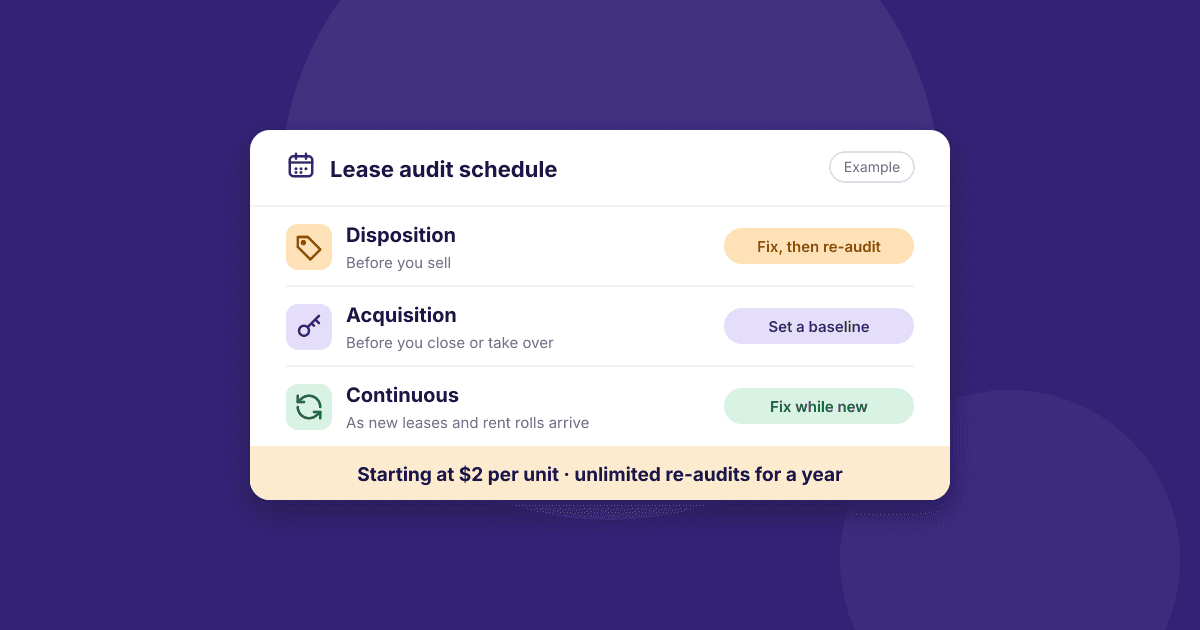
There are three common scenarios where multifamily teams audit leases. Each one has a different trigger and a different question behind it.
| Scenario | What triggers it | The question you want answered | What you do with the result |
|---|---|---|---|
| Disposition (selling) | You plan to sell a property | Will a buyer find problems in our lease files before we do? | Fix what you find, then re-audit before due diligence |
| Acquisition (buying, or taking over management) | A deal under contract, or a new management agreement | Does the rent roll match the leases we are inheriting? | Negotiate, set a baseline, and fix after closing |
| Continuous | New leases, renewals, or a new rent roll | Did each new lease get entered correctly? | Fix it while the lease is new |
Each one has its purpose. Let's go through them one by one.
Disposition: audit before the buyer does
A buyer will compare your latest rent roll with your lease files before closing. Every difference they find is one you could have fixed first.
Selling is the clearest case for an audit, fix, and re-audit cycle:
- Run a first audit to see what is wrong across the property.
- Have your onsite teams fix discrepancies in your PMS or with a new addendum.
- Re-audit to confirm the fixes.
- Run a final audit shortly before buyer due diligence begins to catch anything new.
Starting early matters for a second reason. A missing signature or addendum found months before a sale can be handled in the normal course of business. If found during the sale, it becomes a rushed request to a resident.
Sharing the results with a buyer is optional. The audit is useful on its own because it lets you fix problems before anyone else looks. If you want to show a buyer that your files are in order, you can share it. If you don't, it stays internal. Up to you.
Re-audits matter more here than anywhere else. Each audit round leads to fixes that change the files, and each change needs a new check. If you are preparing a sale, see how Automated Dispositions works in Pivott for your property service contracts as well.
Acquisition: check the rent roll before you close
Before closing, a buyer needs to know whether the rent roll matches the leases. The rent roll shows what residents are billed. The lease files show what residents agreed to. Differences found before closing can be raised with the seller and used in negotiation. Differences found after closing belong to you.
Missing documents are also part of the picture. Files can have missing signatures or addenda, and knowing which units have gaps lets you ask the seller for additional info before closing.
After closing, an audit gives you a clean baseline. Files inherited from a previous management company can have missing pieces from different systems, processes, and documentation standards. A first audit shows what you inherited, so you know where to start.
The same logic applies when you take over a property as a third-party fee manager. A baseline audit at the start of the contract separates inherited problems from the ones that happen on your watch. Security deposit mismatches are among the most common and most sensitive findings because the money is held on a resident's behalf. It is better to find them at takeover than months later, when a resident is upset.
Continuous: catch errors at the lease, not at the sale
Most lease errors start small and stay small until someone looks. A pet is on the lease but not in the ledger. A parking space is assigned but never billed. A concession that ended in month two still shows as a credit in month eight. None of these are hard to fix, yet they all cost more the longer they run.
Take the example from What Is a Lease Audit?: a $50 missed pet fee in 10% of the units across a 200-unit portfolio is $1,000 a month, or $12,000 a year. If the fee was missed from the start, finding it after one month costs you $1,000. Finding it at a sale a year later means the same error has cost $12,000, and the buyer's team can find it before you do.
Continuous auditing does not need a special mode. Each time you have new leases to check, you can run an audit. You choose what to audit them against: a new rent roll, an updated control lease (your standard lease terms), or both. Run one after a busy leasing month or after each rent roll update; the choice is yours.
One error is also a signal. If one unit has a mistake, others likely do too, so audit the whole property, not only the flagged unit, and keep your peace of mind.
The point of auditing continuously is to find a discrepancy while the resident is new and the details are fresh, not months or years later when a sale, a buyer, or a resident forces the question.
Owner/operators and fee managers
The three scenarios we've covered are usually the same for everyone, but the reason for running them is not.
Owner/operators audit their own leases and fix their own files. The result goes to the onsite team, who correct the property management system or send a new addendum. Success looks like revenue recovered, fewer surprises at a sale, and files the company can stand behind.
Fee managers audit leases on behalf of someone else. The reader is often a client: a buyer during an acquisition, or an owner after a takeover. That makes the report as important as the findings. Errors run both ways; a resident can be overcharged as easily as undercharged, so the goal is an accurate record, not just extra revenue.
Owners who hire a fee manager have a third reason: checking that the manager's records match the leases. A baseline audit at takeover, followed by periodic audits, shows whether the property is being run the way the leases say.
| Compared on | Owner/operator | Fee manager | Owner with a fee manager |
|---|---|---|---|
| Whose leases | Their own | Their clients' | Their own, run by someone else |
| Main reason to audit | Recover revenue and prepare for a sale | Report to a client and mark what was inherited | Check the manager's work |
| Who reads the result | Onsite and asset teams | The client, often in a report | The owner or asset manager |
| Who fixes findings | The company's onsite teams | The site team, some at renewal | The manager, at the owner's request |
| When it matters most | Before a sale, and between sales | At an acquisition or takeover | At takeover and at periodic reviews |
The audit is the same in all three cases. What changes is who reads it and what they do next.
One price, three scenarios
Lease Auditor pricing starts at $2 per unit — a fraction of a manual or outsourced audit that can take days or weeks for a single property.
That price is built for the three scenarios in this post. You can run an audit at disposition or acquisition, re-audit after fixes, and check new leases as they arrive, without treating each run like a separate consulting project.
A full audit takes about an hour once a property is set up, so a re-audit does not hold up the work behind it. Plus, if you're checking existing lease files and just changing parameters like rent rolls or control leases, re-audits are nearly instantaneous.
The short answer
Audit before you sell, before you buy or take over, and on a rhythm in between. Owner/operators do it to recover revenue and clean up their files, and fee managers do it to report accurately to a client. With pricing that starts at $2 per unit, the audits in between stay practical — not a one-time project cost.
Frequently asked questions
When should you do a lease audit?
Three times: before you sell a property, before you buy one or take over its management, and on a regular rhythm between those events. The regular audits catch errors while the leases are new.
How often should you audit your leases?
There is no fixed rule. A property with high turnover collects new leases every month, so it has more reasons to audit often. Pricing that starts at $2 per unit makes it practical to audit on that rhythm instead of waiting for the next deal.
Should you audit leases before selling a property?
Yes. A buyer will compare your rent roll with your lease files, so finding and fixing differences first removes surprises. You can then choose whether to share the audit with the buyer.
How much does a lease audit cost?
Pivott's Lease Auditor pricing starts at $2 per unit.
How long does a lease audit take?
About an hour once a property is set up in Pivott. A manual or outsourced audit can take days or weeks.
Do owner/operators and fee managers audit differently?
The audit is the same. The reason differs. Owner/operators audit to recover revenue and prepare for a sale, and fee managers audit to report accurately to a client.
Ready to audit on your schedule?
Pivott's Lease Auditor compares your signed leases with your rent roll and flags the differences. Book a demo to see how an audit works.
Ready to automate?
See how Pivott helps multifamily teams manage contracts, compliance, and vendor documents in one place.
Book a Demo