Missing property contracts are usually discovered at the worst possible time. A major renewal is coming up, a compliance audit is underway, or someone asks for a copy of an agreement that no one can find.
On-site, it’s easy for contracts to end up in different places. Some may be saved locally, others buried in email threads, and some tracked on a spreadsheet that hasn’t been updated in months. Over time, it becomes difficult to know whether every required property service contract is actually on file.
That’s how missing property contracts slip through the cracks, and how important contract details get overlooked.
Landscaping may be active, but is the agreement current?
Is there a signed fire alarm monitoring contract?
Was snow removal formally documented this year, and on which days will service occur?
Without a clear way to compare what services are required against what contracts are actually in place, teams often rely on memory or manual checks.
In this article, we’ll walk through a practical way to identify missing contracts at your property and create a simple system to keep everything accounted for going forward.
Missing property contracts occur when a required vendor service agreement, such as landscaping, pest control, security, or waste removal, is not formally documented or cannot be easily located.
In multifamily operations, these gaps often occur when property management contracts are stored in email, on shared drives, or in spreadsheets rather than in a centralized system. Over time, it becomes harder to confirm which agreements are active and which services are properly covered.
Without clear visibility into these contracts, teams may assume a service is documented when it isn’t.
The first step to identifying missing contracts is to create a list of all required services across the properties in your portfolio.
Oftentimes, we see this list include:
But the list can include any multifamily vendor service that is essential to managing your property.
Every property and portfolio is different, so the goal is simply to capture the full picture of the services your teams rely on to operate each community.
Once you have a complete list, you can compare it against the property service contracts you currently have in place. This makes it much easier to spot services operating without a formal agreement, contracts that may be missing from your records, or vendors that need updated documentation.
From there, your team can quickly fill the gaps and ensure every essential service is properly documented and accounted for.
Most multifamily communities rely on a similar group of vendor service agreements to keep operations running smoothly.
Common property contracts often include:
Tracking these multifamily contracts consistently across your portfolio makes it much easier to identify when something is missing or undocumented.
We hear from teams all the time that they don’t have a single source of truth for their contracts. Agreements are scattered across shared drives, buried in inboxes, or loosely tracked in spreadsheets.
The result is usually the same: unclear ownership and a last-minute scramble whenever a renewal or termination date approaches.
When contracts are managed this way, tracking becomes reactive. Teams only start looking for information when a vendor reaches out, a renewal notice appears, or someone realizes a deadline is coming up. By that point, it often turns into a rush to locate the agreement, confirm the terms, and figure out what needs to happen next.
Because multifamily contract management is often handled this way today, it’s easy for gaps to appear. A service might be assumed to be covered when the contract has actually expired, or a property might realize too late that a vendor service agreement was never formally documented.
At best, this creates unnecessary stress and extra work for the team. At worst, it can leave a property without a critical service or introduce compliance risk.
A more proactive approach can change that. When contracts are centralized and tracked in one place, teams always know what services are active, what agreements are in place, and what deadlines are coming up.
Instead of reacting to surprises, they can stay ahead of renewals, catch gaps early, and make sure every essential service across the portfolio is properly covered.
The best way to prevent missing contracts is to make contract tracking part of your normal operations — not something you only think about during audits or renewals.
It starts by defining the types of services every property should have under contract (like the examples we mentioned earlier). Establishing these categories creates a clear baseline for what “complete coverage” should look like across your portfolio.
From there, you can standardize expectations across properties so teams know which property management contracts should exist at each community. This makes it much easier to identify when something is missing or undocumented.
Instead of relying on memory or manual checks, the system can track which contracts are in place, which ones are missing, and which ones are coming up for renewal.
At the same time, it’s important to allow for flexibility. Not every contract category applies to every property, so teams should be able to mark exceptions when a service truly isn’t needed.
When these pieces are in place, contract management becomes much more proactive. Instead of running occasional audits or scrambling when a deadline appears, teams have ongoing visibility into their contracts and can address gaps before they become problems.
Pivott’s Expected Contracts feature was designed to make this process much easier.
Instead of relying on spreadsheets, memory, or occasional audits, you can define the contracts each property should have from the start.
These categories create a simple framework for what “complete coverage” should look like across your portfolio.
Once those expectations are set, you can upload the contracts to Pivott and associate them with the Expected Contract type. If something is missing, it’s easy to spot. If a contract expires or is coming up for renewal, your team is alerted ahead of time and can take action.
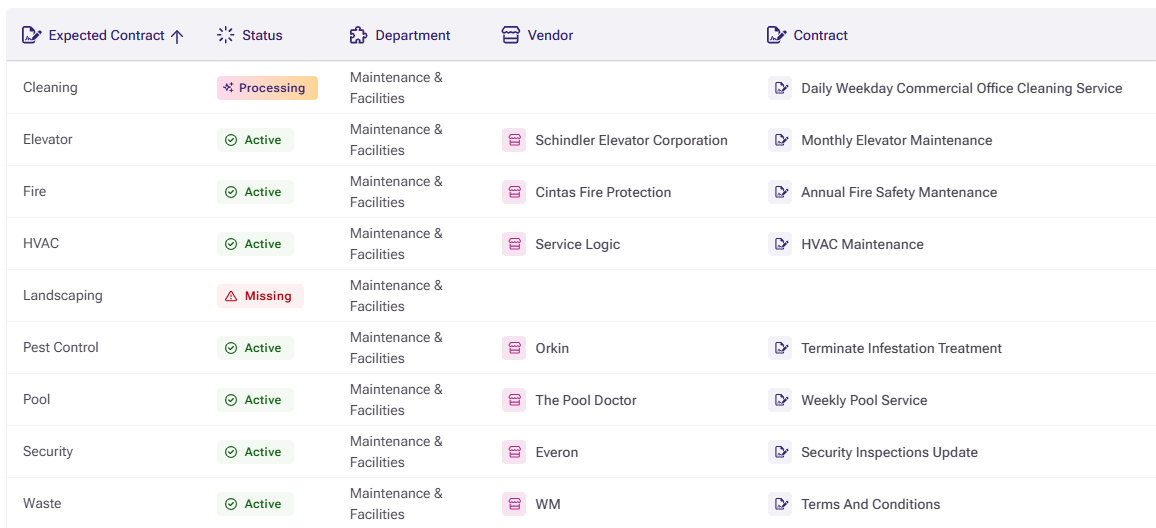
The feature is also flexible. Not every contract category applies to every property, so teams can mark exceptions when a service isn’t needed.
Instead of scrambling to confirm coverage during audits or renewals, your team always has a clear view of what contracts are in place and where gaps might exist. It’s a simple way to move from reactive contract management to ongoing visibility across your portfolio.
Missing contracts are rarely caused by negligence. More often, they happen because agreements are scattered across inboxes, shared drives, and spreadsheets with no clear system to track them.
When contracts are managed this way, gaps can easily go unnoticed until a renewal is missed, a vendor question comes up, or an audit forces the team to track everything down.
The key is having ongoing visibility into what property service contracts should exist and what agreements are actually in place. When teams can quickly see missing contracts, upcoming renewals, and coverage across their properties, they can address issues early instead of reacting at the last minute.
This kind of visibility doesn’t just reduce risk. It also improves operational efficiency and helps ensure properties stay compliant with the agreements that keep them running smoothly.
If your team is looking for a simpler way to stay on top of contracts across the portfolio, Pivott was built to help.