The Costly Pitfalls of Poor Vendor Contract Management

Michelle Cash
Chief Strategy Officer
Key takeaways
- Poor contract management costs companies an estimated 9% of their bottom line — through wasted spend, missed renewals, vendor redundancies, and scope creep.
- Most organizations invest heavily in pre-signature activities like drafting and negotiating, but post-award is where the true value of contract management is either realized or lost.
- Vendor contracts are being stored across multiple locations with no single point of accountability — limiting the use of technology to automate and regain control.
- Centralizing contracts, automating intake, and enabling spend analytics are the highest-leverage improvements multifamily organizations can make.
Those managing any aspect of multifamily portfolio operations face a growing pressure to reduce expenses — from rising property taxes and insurance premiums to labor challenges and slower demand. An often overlooked opportunity to reduce costs lies in improving fiscal control and streamlining the management of vendor and partner contracts.
Why vendor contracts matter
"Contracts are at the heart of every organization. On any given day, at least one-third of employees touch contract data." — MGI Research, LLC
No matter what kind of multifamily business you're in, your organization relies on vendors and vendor contracts. Contracts are the basis of almost all external relationships and are essential to the smooth operation and longevity of a multifamily organization and its properties. No external party is more directly tied to your business's success than your vendors — yet they are frequently treated in a purely transactional manner.
Vendors represent the largest non-salary expense in multifamily. As dependency on vendors continues to grow, so do the challenges that come with the decentralized, disorganized, and manual way they're currently being managed.
The business impact
Poor contract management costs companies an estimated 9% of their bottom line. Many financial and operational challenges stem directly from a lack of visibility and control over vendor contracts.
- Financial loss. Ineffective vendor contract management bleeds costs through wasted spend on underperforming vendors, scope creep, hidden fees, and unplanned spend where vendor redundancies exist across the portfolio.
- Missed expirations and renewals. Failing to track contract expirations leads to rogue spend, loss of essential services, or missed opportunities to renegotiate better rates.
- Transaction disruptions. A lack of centralized contract storage complicates acquisitions and dispositions, impedes due diligence, and can delay or derail transactions entirely.
- Risk exposure. Without a solid contract management process, organizations face financial, operational, and reputational risk — from poor vendor performance and pricing disputes to physical damage to properties and vendor non-compliance.
Signed and forgotten
While plenty of effort goes into selecting, approving, and negotiating vendor contracts, the real value is realized — or lost — after the contract is signed.
A signed contract is an enforceable document. The vendor is legally responsible for their obligations, which makes the contract itself a critical management tool and organizational asset. It should be readily accessible, referenceable, and trackable by key stakeholders.
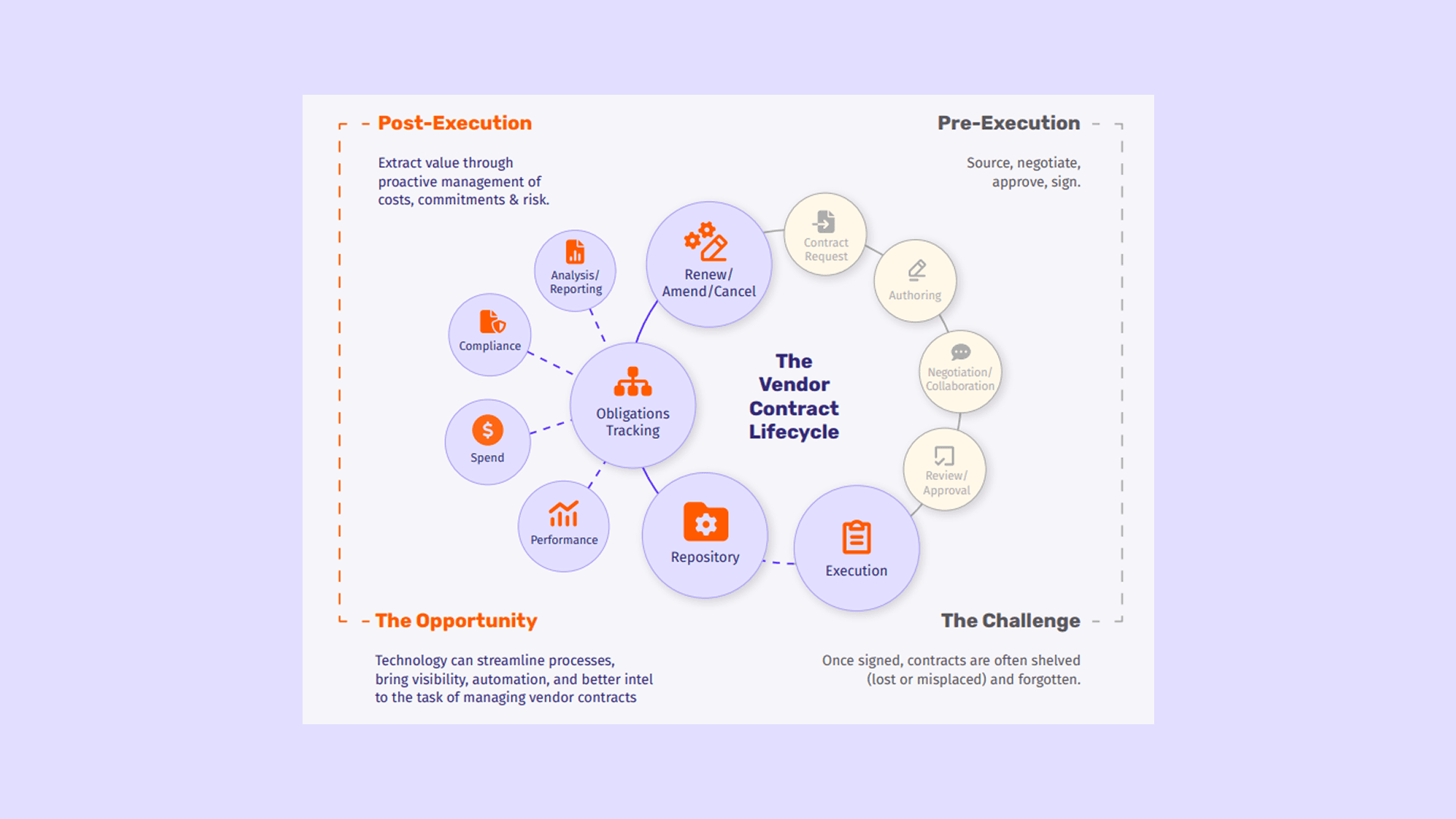
Post-execution, vendor contracts should not be shelved or forgotten. Important work should begin: obligation monitoring, spend oversight, key date tracking for renegotiation or termination, compliance management, and vendor performance reviews. Failure to enforce contracts erodes vendor relationships and prevents organizations from realizing the full value they negotiated.
"The scenario is the worst case of contract management 'halfism' I see, and it happens all the time. And yet, companies still wonder why there are overruns, scope creep, and misaligned expectations. Sadly, these behaviors cost money, time, and relationships — things we shouldn't still be wasting." — Craig Conte, Global & UK Lead Partner, Contracts, Deloitte
The reality is that post-execution vendor contracts are stored across multiple locations, often with no single point of accountability. The biggest pitfall is the limited use of technology to centralize, automate, and regain control of this mission-critical area.
Getting value from the critical second half of VCLM
Technology can play a significant role in strengthening vendor contract lifecycle management (VCLM) post-award. Here's where it makes the biggest difference:
- Contract consolidation. Most contracts arrive via personal email and get scattered across personal hard drives or loosely organized shared folders. Automated contract capture ensures every agreement is stored in a centralized repository without manual effort.
- Centralized repository. A single source of truth for all vendor contracts, organized by property, with full organizational visibility and permission-based access for retrieval and tracking.
- Automation. Streamlines contract intake, categorization, notifications, and reminders — dramatically reducing the manual workload on operations teams.
- Analytics. Advanced reporting surfaces insights into spend, upcoming renewals, and vendor gaps or redundancies across properties and regions — enabling more informed decisions.
- Risk mitigation. Automated alerts flag non-compliance and approaching expiration dates before they become problems.
- Collaboration. Cloud-based access allows teams to work from the same centralized data set, reducing confusion and errors from version fragmentation.
- History. Digital systems maintain accurate contract history, eliminating confusion caused by outdated documents.
- Integration. Connecting contract management with other business systems ensures data accuracy and consistency across the vendor contract lifecycle.
Summary
With expense reduction and operational efficiency at the top of every multifamily operator's agenda, gaining the technology to centralize, streamline, and automate vendor contract management is one of the highest-leverage investments available. It reduces contract neglect and value leakage, improves contract outcomes, saves money, and helps multifamily organizations realize the full value of the vendor relationships they depend on to run their businesses.
Ready to automate?
See how Pivott helps multifamily teams manage contracts, compliance, and vendor documents in one place.
Book a Demo